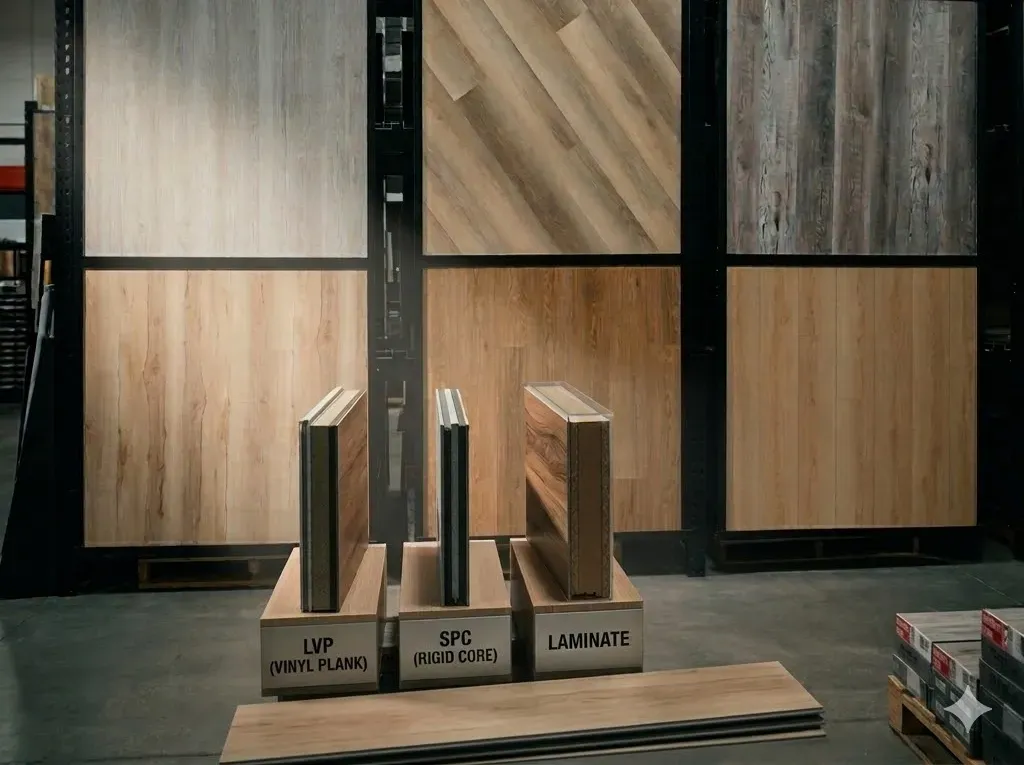
People walk into a flooring store and see three products on the wall that look almost identical — LVP, laminate, SPC — and they leave more confused than when they walked in. I've had homeowners call me after buying the wrong product asking if there's anything we can do. Sometimes there is. Sometimes they're just out a few thousand dollars.
I'm Jay, one of the co-founders of 3 Floor Guys. I handle a lot of our LVP and SPC installations across Central Florida. Let me break this down the way I'd explain it to a family member.
The Short Version First
LVP (Luxury Vinyl Plank) — 100% waterproof, works on concrete slabs, Florida-safe. Good choice for most rooms.
SPC (Stone Plastic Composite) — also 100% waterproof, denser and more rigid than standard LVP, better for slab installs. Think of it as the upgraded version.
Laminate — not waterproof. Should not be installed on concrete slabs. Has no business being in most Florida homes unless you're very careful about where it goes.
That's the summary. But let me explain the why so you can make the right call for your situation.
What Each Product Actually Is
LVP — Luxury Vinyl Plank
LVP is a synthetic flooring product made almost entirely of PVC (vinyl). It has four main layers: a backing for stability, a vinyl core, a photographic film layer printed to look like wood or stone, and a wear layer on top that protects the image from scratches and scuffs.
The key word is vinyl — it does not absorb water. Spill a bucket on it, mop it up, and you're fine. That's why it's become so popular in Florida.
SPC — Stone Plastic Composite
SPC is LVP's heavier, denser cousin. Instead of a soft vinyl core, it has a core made from limestone powder mixed with plastic resins. This makes it significantly more rigid and dimensionally stable — it doesn't expand and contract as much with temperature changes.
In Florida, where a house can swing from a well air-conditioned 72°F to 90°F when the power goes out, that thermal stability matters more than it does in a northern climate. SPC is also harder underfoot — more resistant to denting — and easier to install flat on an imperfect subfloor because the rigidity bridges minor dips in the slab.
Laminate
Laminate is made of a high-density fiberboard (HDF) core with a photographic layer on top and a protective coating. The core is wood-based, and wood absorbs moisture. Even "water-resistant" laminate just means it sheds surface spills for a short window before water seeps into the seams.
Once moisture gets into the HDF core — through a slab, through a seam, through a slow leak under the refrigerator — the board swells and the floor is done. You'll see bubbling, lifting edges, and gaps that won't go back. It's not repairable at that point; you're replacing the whole floor.
The Florida Problem with Laminate
Central Florida's average relative humidity sits between 70–90% for most of the year. The ground itself is damp. About 70% of Florida homes are built on concrete slabs, which radiate moisture upward constantly — especially in the first few years after a home is built.
Even with a vapor barrier, putting laminate on a concrete slab is a risk I wouldn't take in my own house. I've pulled up laminate installs in Central Florida that failed in under 18 months because of moisture migration from the slab. The showroom salesperson doesn't always tell you this. I am telling you now.
If you're in a two-story home and the laminate is going on the second floor — no slab contact, no below-grade moisture — you have more flexibility. But ground-floor installs in Florida should be LVP or SPC, full stop.
Head-to-Head: LVP vs SPC vs Laminate
| Feature | LVP | SPC | Laminate |
|---|---|---|---|
| 100% Waterproof | ✅ Yes | ✅ Yes | ❌ No |
| Concrete Slab Safe | ✅ Yes | ✅ Yes | ⚠️ Risky |
| Core Material | Vinyl (flexible) | Stone composite (rigid) | HDF (wood-based) |
| Dimensional Stability | Good | Excellent | Fair |
| Underfoot Feel | Softer, warmer | Solid, firm | Closest to real wood |
| Dent Resistance | Good | Excellent | Good |
| Typical Installed Cost | $4–7/sq ft | $5–9/sq ft | $3–6/sq ft |
| Expected Lifespan (FL) | 15–25 years | 20–30 years | 5–15 years |
| Refinishable? | ❌ No | ❌ No | ❌ No |
LVP vs SPC: Which Do I Actually Recommend?
For most homeowners, either works fine. LVP is lighter, slightly softer underfoot, and a bit less expensive per square foot. SPC is stiffer and more dimensionally stable — I prefer it for large open floor plans where LVP might show slight expansion lines at doorways in a hot Florida summer with fluctuating indoor temps.
If your slab is slightly uneven, SPC's rigidity helps — it bridges minor low spots better than flexible LVP. LVP follows the subfloor more closely, which is great if your slab is perfectly flat, but it can telegraph imperfections on an uneven surface.
The wear layer thickness matters more than the LVP vs SPC distinction for long-term durability. Look for 12 mil or higher for standard residential use. If you have dogs, kids, or a lot of foot traffic, go 20 mil or above. Don't let a salesperson sell you on a brand name — 20 mil from a mid-tier brand outlasts 6 mil from a premium brand every time.
When Laminate Actually Makes Sense
I don't want to write laminate off entirely — there are legitimate use cases:
- Second floor only, no slab contact. Bedrooms or an upstairs bonus room with a wood subfloor and no moisture issues can work well with laminate, and it costs less than LVP.
- Short-term or rental installs. If you're renovating a property and prioritizing cost over longevity, laminate gets it done while conditions are dry.
- Rooms with zero water risk. A formal dining room or study that will never see a wet mop and has low humidity might be fine. Emphasis on "might."
Even in those cases, I'd ask: why not just do LVP? The price difference is usually small, and you eliminate the moisture risk entirely. It's a no-brainer in Florida.
Don't Forget the Underlayment
Most SPC and many LVP products come with pre-attached underlayment padding. This helps with sound absorption and makes the floor feel less hollow underfoot. On a concrete slab, you still want a vapor barrier — either separate or verify that the attached pad qualifies as one for your specific install conditions.
If your product doesn't include attached underlayment, we add 2mm or 3mm foam during installation. Don't skip it on a slab — the small added cost is worth it for both comfort and moisture protection over the life of the floor.
Learn about our LVP installation services in Central Florida →