If you have dogs, you've probably already noticed what they do to floors. Nails click-clack across hardwood and leave fine scratches in the finish. Heavy breeds leave dents. A dog that drinks sloppily from a water bowl leaves puddles at the edge of whatever you've installed. And anyone who's dealt with a pet accident on the wrong flooring knows exactly what I mean when I say "the wrong material."
I'm Dennis, co-founder of 3 Floor Guys. We do a lot of work in homes with dogs — and I've seen what holds up and what doesn't. Here's the honest breakdown.
Quick Rankings — Flooring for Dogs
- 1.LVP / Vinyl — Best overall for dog owners. 100% waterproof, handles accidents and nails, zero maintenance anxiety.
- 2.Tile / Porcelain — Completely impervious to moisture and scratches. Cold underfoot, hard on joints.
- 3.Solid Hardwood — Beautiful, refinishable, long lifespan — but requires real care. The right choice if you're willing to make the investment.
- ✗Engineered Hardwood — Gives you the cons of real wood without the refinishing longevity. Not what we'd recommend for dog homes.
- ✗Laminate — Avoid. Not waterproof. One bad accident and you're replacing it.
What Dogs Actually Do to Floors
Before getting into materials, it helps to understand the three ways dogs damage flooring:
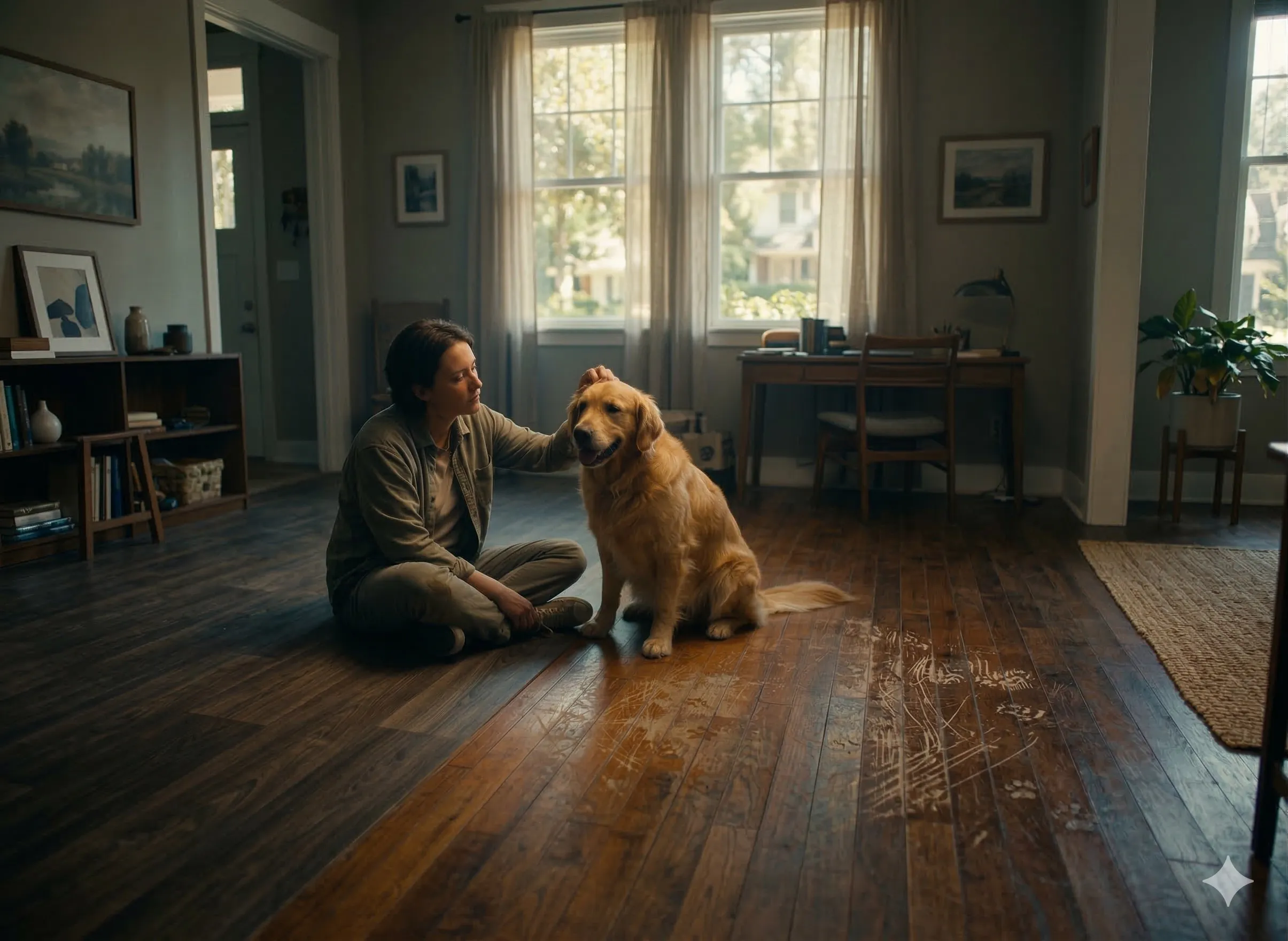
- Nail scratches: Fine surface scratches from nails clicking on hard floors. Cosmetic — affects the finish layer, not the wood or core. Most visible on dark-stained hardwood.
- Dents and gouges: Usually from large breeds, dropped bowls, or toys with metal parts. This penetrates the wear layer and affects the material itself.
- Moisture: Water bowl spills, accidents, and wet paws from outside. The biggest structural threat — what causes subfloor damage and warped boards over time.
LVP and Vinyl — The Easy Choice
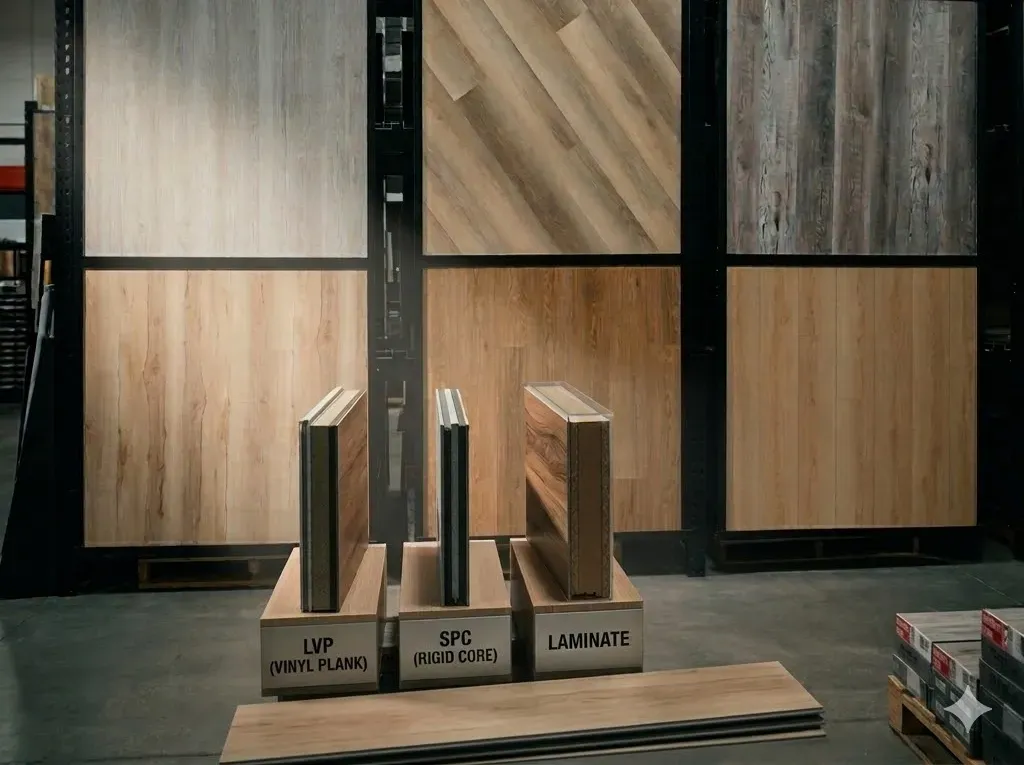
If you want the path of least resistance, vinyl flooring is it. It's 100% waterproof, handles nail scratches well, and a pet accident is never an emergency — wipe it up and move on. We've installed LVP in homes with multiple large dogs and seen it hold up well for years.
The tradeoff is that vinyl can't be refinished. When the wear layer is scratched through or the floor starts to look tired, you replace it. For a lot of dog owners, that's a perfectly acceptable deal — and the cost savings upfront are real.
- Wear layer to look for: 12 mil or higher for dogs. 20 mil for large breeds or multiple dogs.
- Price range: $7–$12/sq ft installed
- Bottom line: Low maintenance, no stress, works great in dog homes.
Hardwood Floors With Dogs — What's Realistic
A lot of dog owners want hardwood floors. I understand — they look better, they're real wood, and they add value to the home. Hardwood with dogs is absolutely doable, but go in with clear eyes.
Hardwood with dogs will get scratched. Not eventually — soon. This isn't a failure of the floors; it's the nature of the material. The upside is that unlike vinyl, you can sand those scratches out and refinish. That's the real case for hardwood in a dog home — not that it won't get damaged, but that the damage is fixable.
Species Hardness Matters
Wood hardness is measured by the Janka scale. Higher = harder = more scratch and dent resistant. For dog owners:
- Best choices: Brazilian Cherry (2,350 Janka), Hickory (1,820), Hard Maple (1,450), White Oak (1,360)
- Acceptable: Red Oak (1,290) — the most common hardwood in Florida homes. Scratches, but refinishable.
- Avoid with large dogs: Pine (870), Cherry (950), Walnut (1,010) — soft enough that large breeds will dent them
Finish Choice for Dog Homes
Gloss finish shows every scratch. Matte and satin finishes hide them far better. Wire-brushed and hand-scraped textures are the best choice for dog owners — the distressed surface camouflages scratches because there's already texture to absorb visual noise. A smooth, high-gloss white oak floor with two labs will drive you crazy. The same white oak in a wire-brushed matte finish looks fine for years.
We always recommend a third coat of polyurethane for dog homes. More finish between the wood and your dogs' nails.
The Refinish Advantage
After 10–15 years with dogs on hardwood, you can sand out all the scratches and start fresh. You can't do that with vinyl. If you're in your home for the long term and want real wood, this is the argument for it. We refinish a lot of floors in Orlando homes that have clearly had large dogs for a decade — they come out looking new. That's the investment side of hardwood.
Why We Don't Recommend Engineered Hardwood for Dog Homes
Engineered hardwood gets marketed as a middle ground — real wood look, better moisture resistance, lower price. In a dog home, it's the worst of both worlds.
You still get all the cons of real wood: it scratches, it responds to moisture, accidents still require fast cleanup. But you lose the main benefit — engineered hardwood can only be refinished 1–3 times before you've sanded through the veneer. With dogs putting wear on the floor consistently, you burn through those refinishes fast. At that point, you're replacing the floor anyway, and you paid more than LVP upfront.
Our recommendation is simpler: either commit to real hardwood and take care of it, or go with vinyl and don't worry about it. Engineered hardwood in a dog home lands in an awkward middle ground that doesn't serve you well in either direction.
The Moisture Problem: Pet Urine on Hardwood
The most common floor failure I see in pet homes isn't scratches — it's moisture damage, and the worst version of it is pet urine on hardwood that sat too long.
With vinyl, a pet accident is never an emergency. Clean it up whenever you find it. With hardwood, it's a different story entirely.
Pet Urine Black Staining — What's Actually Happening
When dog urine soaks into hardwood and is left to sit, the urea triggers a chemical reaction with the wood's tannins. The result is a deep black stain that isn't on the surface — it's in the wood fibers themselves. This is not a finish problem. It's not something you can buff off or sand away.
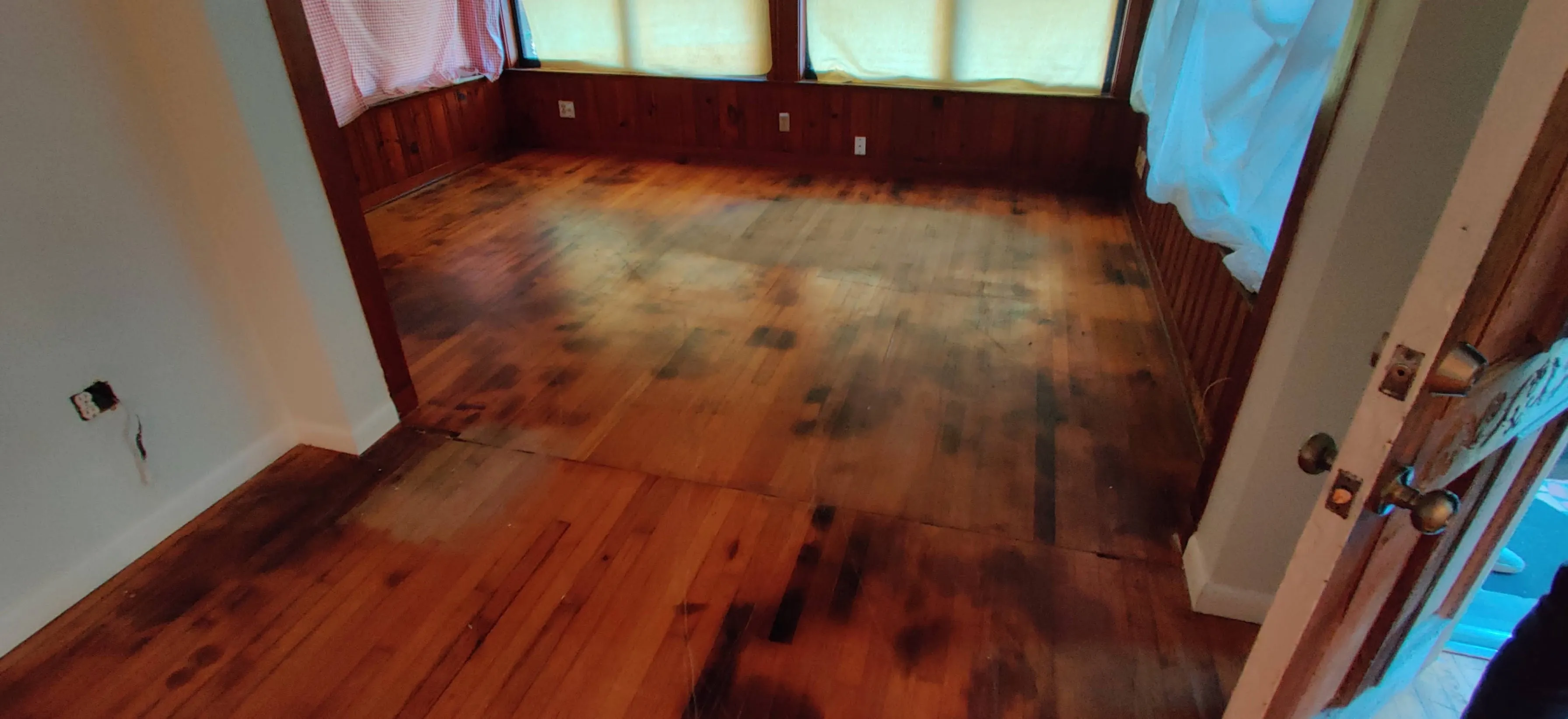
A pet urine stain job we worked on — the black goes deep into the wood fibers. This is from 2019 but we still see floors like this regularly.
We see this on assessments regularly: black staining around a door frame, in a corner of a bedroom, or along a baseboard where a dog was marking. When we sand into it, the stain often goes through the entire board. You can sand the floor flat, but the black doesn't fully come out.
The only real fix is to go dark. A dark stain — ebony, dark walnut, jacobean — masks the discoloration and gives you a uniform result. If you want to keep a natural or light floor color, the affected boards need to be replaced.
Some homeowners have had partial success with hydrogen peroxide and baking soda paste — apply it to the stain, cover with plastic wrap overnight. The oxidation can lighten the black. But the results are never perfect: you typically trade a black spot for a lighter spot that takes stain differently from the surrounding wood. It's a partial fix at best.
If you're buying a home with dogs that lived there
Always check corners, closets, and areas near exterior doors before assuming the hardwood is refinishable. Black staining is often lurking under area rugs or in low-traffic spots the seller didn't mention. We check for this on every assessment.
Floors to Avoid
Laminate — not waterproof, not fixable once moisture gets in. A spilled bowl, a rainy-day paw print, an accident that sits for an hour — any of these can permanently damage laminate. We've replaced a lot of laminate in pet homes. Not one LVP floor yet.
Engineered hardwood — as covered above, you get the downsides of wood without the refinishing lifespan. Not worth it in a dog home.
Our Recommendation
It comes down to two honest options:
Go with vinyl if you want ease. Waterproof, durable, no stress about accidents. Lower upfront cost and zero maintenance anxiety. Most dog owners who go this route don't regret it.
Go with solid hardwood if you want the real thing. Choose a hard species, go matte or wire-brushed, get that third coat of polyurethane, and plan to buff and coat every few years and refinish when it needs it. Hardwood with dogs requires more care — but when you refinish those floors after a decade, you'll be glad you went with the real thing.
If you already have hardwood: Don't rip it out just because you got a dog. Buff and coat every 3–5 years to maintain the finish. Refinish when the scratches bother you enough. The floors will outlast the dogs.
Have dogs and not sure which floor will hold up?
We've seen every combination of breeds and flooring. Free in-home estimates across Orlando and Central Florida — we'll tell you exactly what will and won't work for your situation.
Get Your Free Estimate →